







The Work of the People
Our worship services are organized by liturgy, which comes from a simple Greek word meaning “work of the people.” We believe all participants play a vital part in bringing the words we sing, say and pray to life.
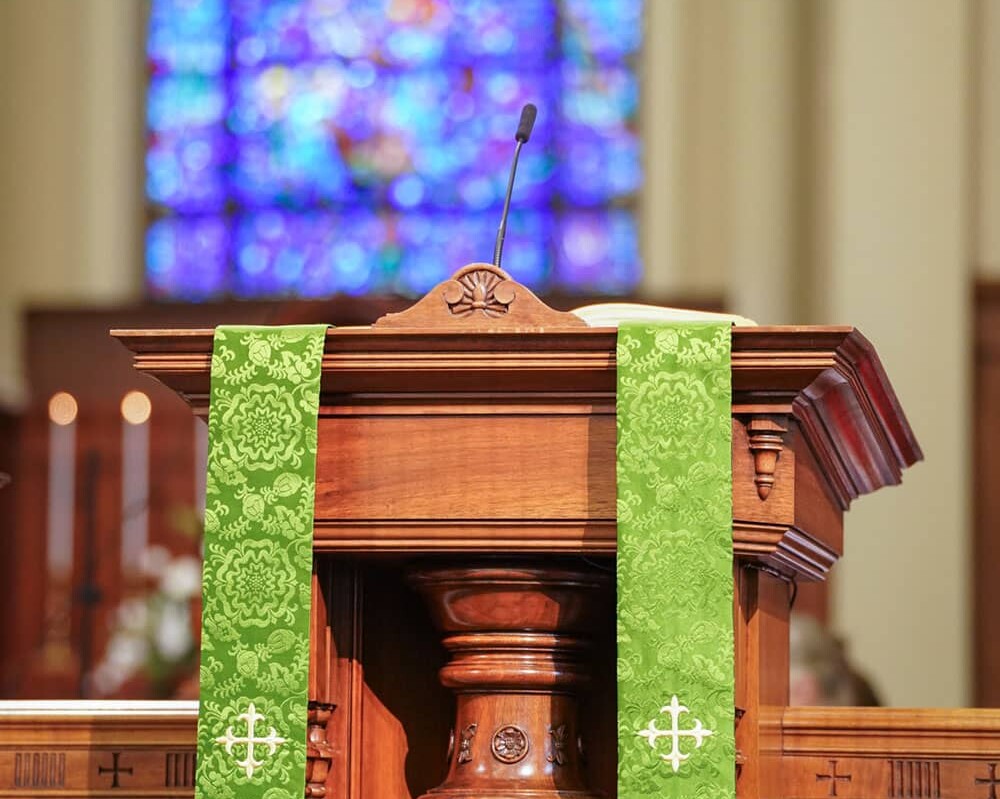
Our worship uses the liturgical calendar to shape and center each season so we can follow the primary narratives of the life of Jesus of Nazareth. Beginning with Advent, each season is represented by a color that will adorn the Sanctuary and be worn by the clergy.
We also recognize there are days and seasons during the year we need to celebrate and mark in significant ways, as citizens and people of faith. We integrate those days and seasons with the liturgical calendar to curate a rhythm of life that is meaningful and engaged in our world.
Advent comes from the Latin word adventus, meaning “coming” or “arrival.” The season of Advent encompasses the four Sundays leading up to Christmas, a time of anticipation and preparation for the celebration of Christ’s birth. Among the most cherished Advent traditions is the Service of Lessons and Carols, which weaves together Scripture readings and seasonal music to tell the story of the long-awaited arrival of Jesus.
Our Christmas celebration begins on Christmas Eve, December 24, but the season continues for twelve days through January 5, inspiring the beloved tradition of “The Twelve Days of Christmas.” Throughout this festive season, we commemorate the birth of Christ through worship, music, and storytelling that proclaim the joy and wonder of God’s gift to the world. Our service ends with the singing of Silent Night by candlelight.
Observed on the Sunday nearest January 6, Epiphany tells the story of the Magi who followed a star in search of the newborn Christ. The word epiphany means “manifestation” or “revelation,” and the season celebrates the revealing of Christ to the nations. This revelation proclaims that God’s grace is not limited by geography, culture, status, or tradition, but extends to all people, calling us to live beyond the barriers and divisions that separate us.
Each year, we commemorate the founding of our church in January 1943 by remembering the people, stories, and milestones that have shaped our community. As we give thanks for their faith, vision, and dedication, we also renew our commitment to carrying their legacy forward and building upon it for future generations. To learn more about our history, visit our Our Story page.
On the third Sunday in January, we honor the life and witness of Rev. Dr. Martin Luther King Jr. and celebrate his enduring legacy of justice, equality, and service. In his spirit, we reaffirm our call to the ongoing work of justice, reconciliation, and beloved community in our congregation, our city, and our world.
Each February, we observe Black History Month through worship, learning, and reflection. We celebrate the gifts, leadership, and witness of Black communities, highlighting the contributions of Black musicians, preachers, and leaders whose voices have shaped the Christian faith and the broader pursuit of justice. Throughout the year, we are committed to listening to, learning from, and amplifying Black voices as an essential part of our faith formation, seeking to better understand Jesus’ call to justice, inclusion, and beloved community.
Ash Wednesday marks the beginning of Lent, the forty-day season that invites us to prepare our hearts for the celebration of Easter. Rooted in the forty days Jesus spent in the wilderness, Lent is a time for prayer, self-examination, repentance, and spiritual renewal as we seek to draw closer to God and one another.
During this service, ashes are placed in the shape of a cross on our foreheads as a reminder of our mortality and our dependence on God’s grace. Through the shared practices of the imposition of ashes, baptism, and communion, we begin the Lenten journey together, committing ourselves to lives of deeper faith, greater compassion, and faithful discipleship.
Lent is the forty-day season of preparation for Easter, rooted in the forty days Jesus spent in the wilderness while being tempted. Through prayer, reflection, and spiritual renewal, we seek to draw closer to God and more faithfully embody Christ’s love in the world. Throughout the season, our worship is shaped by a common theme and enriched by opportunities for personal study, communal learning, and faithful practice as we journey toward Easter together.
During the season of Lent, we observe Women’s History Month, celebrating the gifts, leadership, and sacred witness of women throughout history and in our world today. Grounded in worship led by women, our observance honors the ways women have shaped the church, advanced justice, and reflected the image of God in diverse and powerful ways. Through worship, learning, and community engagement, we amplify women’s voices and recommit ourselves to the full inclusion of women in every aspect of faith and life.
Palm/Passion Sunday begins Holy Week by holding together two powerful moments in the life of Jesus: his triumphant entry into Jerusalem and his journey toward the cross. Waving palm branches, we commemorate the crowds who welcomed him with joy and hope. As worship continues, the story turns toward Christ’s passion, inviting us to reflect on the depth of God’s love and the cost of discipleship. The service ends with a wooden cross carried from the sanctuary and the congregation following in prayerful procession. Outside, worshipers may place their palms at the foot of the cross as a lone violin plays O Sacred Head, Now Wounded, creating a moving transition into the sacred days ahead.
Easter is both a day and a season, celebrated for fifty days from Easter Sunday through Pentecost. As the centerpiece of the Christian year, Easter proclaims the good news of resurrection and new life. Throughout the Season of Easter, we celebrate the conviction that neither hate, injustice, nor death has the final word. Instead, we bear witness to God’s ongoing work of love, liberation, reconciliation, and renewal in our lives, our communities, and our world.
Our Easter celebration is one of the most joyful services of the year. Accompanied by brass and filled with the voices of the congregation singing Jesus Christ Is Risen Today, and the ringing of Alleluia bells, a festive and beloved tradition that proclaims the good news of resurrection and invites all to share in Easter’s joy.
During May, we celebrate Asian American and Pacific Islander Heritage Month by honoring the gifts, leadership, and witness of AAPI communities. As we learn from their stories and experiences, we celebrate the rich diversity of God’s creation and recommit ourselves to building a more just and inclusive world.
On Pentecost Sunday, we celebrate the birth of the Church and the coming of the Holy Spirit. Through the retelling of the Acts 2 story, we remember how the Spirit opened doors, crossed boundaries, and united people across differences of language and culture. We celebrate Pentecost because we believe the Spirit is still at work today, calling us to cross boundaries, welcome the stranger, pursue justice, and participate in God’s ongoing work of reconciliation and renewal.
Each August, we celebrate Pride Sunday through worship, prayer, and public witness. We honor the gifts, leadership, and sacred worth of LGBTQ+ people, affirming that all are created in the image of God and worthy of love, dignity, and belonging. Following worship, we join together in the Charlotte Pride Parade and Festival, as a public witness celebrating the diversity of God’s creation and recommitting ourselves to the ongoing work of inclusion, justice, and beloved community. For more on our unconditional love and acceptance of persons who identify as LGBTQ+, see Our Statements.
Welcome Week marks the beginning of a new program year in the life of our church. The week begins with a celebratory worship service that invites us to recommit ourselves to the vision of our founders while casting a shared vision for the year ahead. Created as a time of renewal and reorientation, Welcome Week helps us reconnect with one another and with our mission as a congregation. As summer travel and activities come to a close, we gather once again for spiritual growth, fellowship, community engagement, and the ongoing work of justice, strengthening the bonds that unite us as we journey together in faith.
From September 15 to October 15, we celebrate National Hispanic Heritage Month by honoring the history, culture, and contributions of Hispanic and Latino communities. We seek to learn from and amplify Hispanic voices while reaffirming our commitment to justice, inclusion, and the dignity of every person.
Observed on the first Sunday in October, World Communion Sunday joins Christians across denominations, cultures, nations, and languages in the shared celebration of the Lord’s Supper. Established in the aftermath of World War I and amid rising nationalism, the observance bears witness to the unity of the global Church and the conviction that our common faith transcends political, cultural, and geographic boundaries. We celebrate World Communion Sunday as an affirmation of Christianity’s rich diversity and as a reminder of our calling to live as one body, working together for justice, peace, and beloved community throughout the world.
On the second Sunday in October, we honor the lives of indigenous peoples who hallowed the ground we now live upon, and we call society into action to find tangible ways to take care of their descendants.
Land Acknowledgement | Long before Columbus got lost at sea and white settler colonists arrived to displace indigenous nations, the Catawba people created a beautiful civilization on this land that they tended carefully and sustainably. The Catawba call themselves “the people of the river” because they have always lived along this particular watershed. It is their longest and most cherished relationship. The Catawba called Charlotte the “land of the persimmons,” a plant which once heavily populated our city. We acknowledge the Catawba people are still here and we offer our deep gratitude to the Catawba people for being the host people of this land that we worship on and for their stewardship of this place we now call our home and our church.
On the first Sunday in November, we gather to remember and celebrate the communion of saints, giving thanks for those in our community who have died during the past year. Through the reading of names, the ringing of a bell, and the lighting of candles, we honor their lives and entrust them to God’s eternal care. We also remember the saints of every generation whose faith and witness continue to guide and inspire us. As we give thanks for these spiritual ancestors, we recommit ourselves to carrying their legacy of love, justice, and faithfulness into the future.
Where Do We Get Our Stories?
Revised Common Lectionary
Generally, we use the Revised Common Lectionary to shape our worship services. From the songs we use to the texts we preach from, they typically come from that week’s assigned readings, developed over the last 30 years and used in churches all over the world.
Other Lectionaries
We also use diverse lectionaries, including but not limited to Wil Gafney’s A Woman’s Lectionary for the Whole Church.